


You need to do cold outreach today.
You have even broken down the task into smaller steps: identify ideal clients in New York, study their profiles and make notes, customize the template to fit each persona, and send the message.
You have also prioritized your tasks for the day. This outreach task is both high-urgency and high-priority.
And yet, at the end of the day, you go to sleep with everything done except this one task.
If you already know what to do, why can’t you get yourself to do it?
This is one of the clearest examples of the knowing-doing gap: you know what needs to be done, but something keeps getting in the way of taking action.
It is an incredibly frustrating experience. Freelancers who experience this can become consumed by guilt over not completing the task, even when there may be a perfectly valid reason for the delay.
That guilt can turn into shame, which can make it even harder to return to the task and actually do it.
If you experience this, you are not alone.
What Is the Knowing-Doing Gap in Psychology?
| Quick Answer: The knowing-doing gap is the difference between knowing what you should do and actually doing it. For freelancers, it often appears when a task is important but triggers avoidance, uncertainty, perfectionism, overwhelm, or other behavioral patterns that make action difficult. |
Understanding knowing-doing gap psychology can help explain why knowing what to do does not always translate into actually doing it. (Pfeffer & Sutton, 2000)
Sometimes, the problem really is time. But when you repeatedly postpone a task despite knowing exactly what needs to be done, time may not be the whole explanation. Underlying behavioral patterns can keep pushing the task further down your list until the day is over, leaving you with little time or energy to complete it.
What the Knowing-Doing Gap Looks Like for Freelancers ?
If you have experienced this, you may also have noticed something interesting: it tends to happen with certain kinds of tasks more than others.
The task may have one or more of these characteristics (Steel, 2007):
- The outcome feels uncertain.
- The task feels too large or burdensome.
- You are relying on motivation.
- You don’t know what a finished version of that task would look like.
- You are afraid you will not do the task perfectly.
- You have too many priorities.
These kinds of tasks can make you feel drained before you even begin. That is often where the small postponements start: “I’ll do it after this,” or “I know how to do it, so it will be easy.”
But when you still cannot bring yourself to do the task, the confusion can quickly turn into guilt and shame.
“Why can’t I do this even if I know how to do it?”
Well, for starters, being kind to yourself can help.
What Causes the Knowing-Doing Gap?
Being kind to yourself is not just a positivity practice. It can also be a productivity one. (Sirois, 2014)
If you keep questioning yourself and feeling ashamed and guilty, you may never get close to understanding why this happens.
The knowing-doing gap can persist because of automatic behavioral patterns that influence how you respond when a particular task appears on your list.
These patterns can contribute to the knowing-doing gap:
- Avoidance: You look for smaller, easier tasks when the important one feels uncomfortable.
- Overthinking: You keep researching or planning because preparation feels safer than taking action.
- Self-Doubt: You question whether you are capable of completing the task before you begin. (Bandura, 1977; Steel, 2007)
- Perfectionism: You delay starting because you are worried the finished work will not meet your standards.
- Short-term Emotional Relief: Doing something else temporarily reduces the discomfort associated with the difficult task.
- Self-Criticism: After delaying the task, guilt and shame make returning to it even harder.
These thoughts and feelings can appear so subtly that you may not notice them until you deliberately pay attention to what happens when you try to begin the task.
How the Knowing-Doing Gap Turns Into a Cycle?
By the time you finally return to the task, the day may already be over, or you may have become occupied with something else.
For many freelancers, the knowing-doing gap creates a cycle of procrastination, guilt, and overplanning (Sirois & Pychyl, 2013; Steel, 2007):
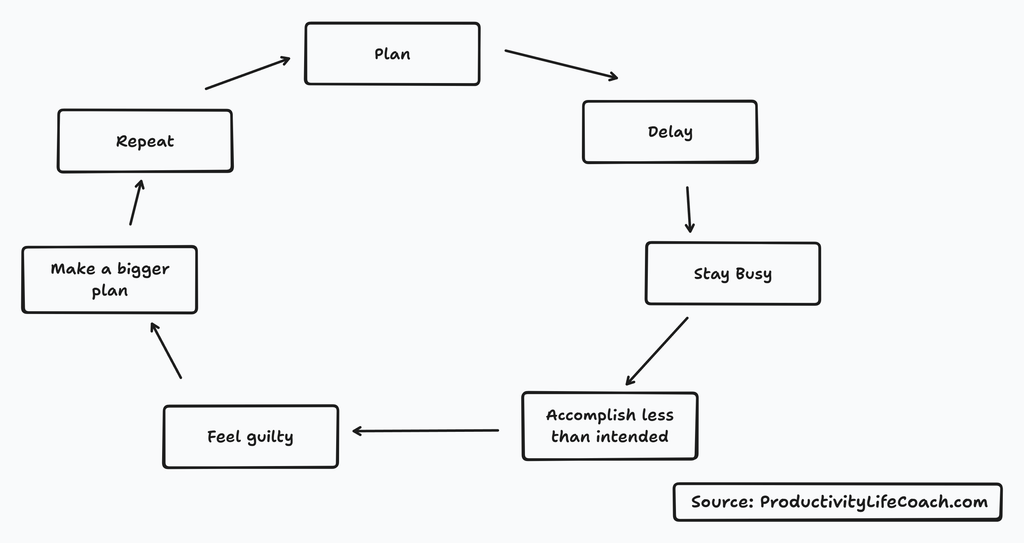
The next time you find yourself in this cycle, pause and explore what is happening beneath the surface. What thoughts, feelings, or doubts appear when you try to begin the task?
Closing the Knowing-Doing Gap
Closing the gap between knowing and doing starts with identifying what is preventing action, rather than immediately looking for another productivity strategy.
Think about an important task you have been delaying.
What thoughts, feelings, or patterns tend to appear when you need to do it?
The reason may be emotional. It may be practical. Or it may be a behavioral pattern you have not noticed before.
Once you understand what is getting in the way, you can address the underlying issue and decide what the next action actually needs to be.
You may not need more information or another system.
You may need clarity about why this keeps happening, along with enough structure and accountability to support follow-through.
For freelancers who work independently, accountability can provide the external structure when there is no manager, team, or workplace deadline creating pressure to follow through.
The Mistake Most Freelancers Make: Waiting for Motivation
One common mistake freelancers make is relying on motivation to complete tasks they already know they need to do.
When you experience the knowing-doing gap, your first instinct may be to ask, “Why am I so lazy or unmotivated?” instead of asking what is actually making it difficult to start the task.
But relying on motivation alone is not always a reliable way to get tasks done. It fluctuates, and waiting to feel motivated can keep you stuck in the same cycle.
Clarity and structure make consistent action less dependent on how motivated you happen to feel.
If you want to explore how to build consistent action without depending on motivation, read How to Follow Through Without Relying on Motivation.
Frequently Asked Questions (FAQs)
What Is the Knowing-Doing Gap?
The knowing-doing gap is the difference between knowing what you should do and actually doing it. It occurs when knowledge or intention does not consistently translate into action.
Why Do I Know What to Do But Still Don’t Do It?
Knowing what to do does not automatically remove the emotional or behavioral barriers that can make action difficult. Uncertainty, overwhelm, perfectionism, lack of clarity, competing priorities, and reliance on motivation can all contribute to delayed action.
How Do You Close the Knowing-Doing Gap?
Start by identifying what happens when you try to begin the task. Understanding the thoughts, emotions, and behavioral patterns behind avoidance can help you address the actual barrier rather than simply adding another productivity system.
Is the Knowing-Doing Gap the Same as Procrastination?
Not exactly. Procrastination can be one way the knowing-doing gap appears, but the gap is broader: it describes the disconnect between knowing what to do and translating that knowledge into action.
References & Further Reading
For readers interested in exploring the psychology and behavioral science behind the knowing-doing gap, procrastination, self-regulation, and translating intentions into action:
Bandura, A. (1977). Self-efficacy: Toward a unifying theory of behavioral change. Psychological Review, 84(2), 191–215. https://doi.org/10.1037/0033-295X.84.2.191
Gollwitzer, P. M. (1999). Implementation intentions: Strong effects of simple plans. American Psychologist, 54(7), 493–503. https://doi.org/10.1037/0003-066X.54.7.493
Pfeffer, J., & Sutton, R. I. (2000). The knowing-doing gap: How smart companies turn knowledge into action. Harvard Business School Press.
Sirois, F. M. (2014). Procrastination and stress: Exploring the role of self-compassion. Self and Identity, 13(2), 128–145. https://doi.org/10.1080/15298868.2013.763404
Sirois, F. M., & Pychyl, T. A. (2013). Procrastination and the priority of short-term mood regulation: Consequences for future self. Social and Personality Psychology Compass, 7(2), 115–127. https://doi.org/10.1111/spc3.12011
Steel, P. (2007). The nature of procrastination: A meta-analytic and theoretical review of quintessential self-regulatory failure. Psychological Bulletin, 133(1), 65–94. https://doi.org/10.1037/0033-2909.133.1.65