

Why you don’t follow through even when you know exactly what you need to do can be frustrating. You know exactly what you need to do today.
- Finish the client project.
- Send the invoice.
- Update your portfolio.
- Follow up with two potential clients.
Simple enough.
You start with the client project because that has a deadline. Then the client messages with one small revision. While replying, you notice another email. You answer that too.
By lunchtime, the client project is done. The invoice gets sent. You even clear three tiny tasks that have been irritating you all week.
Not bad.
Now you just need to update your portfolio.
“I’ll do it after lunch.”
After lunch, you feel slightly tired.
“I’ll start at 3.”
At 3:10, you decide you should probably research how other freelancers structure their portfolios first.
At 4:30, you have fourteen tabs open.
At 5, another client messages.
And somewhere around 7:30, you realize you still haven’t touched your portfolio.
Again.
Now you are annoyed.
You knew what you needed to do.
You had enough time.
You were working almost the entire day.
So why don’t you follow through?
Maybe because follow-through was never one simple problem.
What Is Follow Through?
| Follow-through is the ability to translate an intention, decision, or plan into action and continue until the relevant commitment is completed. A lack of follow-through does not necessarily mean you are lazy or incapable of working. Avoidance, unclear tasks, unrealistic plans, weak accountability, fluctuating motivation, competing demands, and poor recovery can all interfere with action. |
You can be hardworking and still struggle with follow-through.
Freelancers experience a particularly confusing version of this.
- You deliver client projects.
- Attend meetings.
- Reply to emails.
- Make revisions.
- Send invoices.
And still end the week wondering:
“Why didn’t I do the things I promised myself I would do?”
There may be several different answers.
You Know What to Do, but Knowing is Not Doing
Sometimes you already know everything.
You know you should pitch new clients.
You know your portfolio needs updating.
You know you should finally publish the page sitting in your drafts.
And yet…
“I’ll do it after this.”
“I need to think about it properly first.”
“I’ll start fresh tomorrow.”
This is the knowing-doing gap: the distance between understanding what needs to happen and actually translating that knowledge into action.
The difficult task may involve uncertainty, perfectionism, overwhelm, self-doubt, or simply an unpleasant feeling you would rather avoid.
Research on procrastination suggests that postponing a task can sometimes provide short-term emotional relief, even when it creates problems for your future self. (Sirois & Pychyl, 2013)
So you open your inbox instead.
Your inbox gives you something easier.
Something concrete.
Something you can finish.
And, temporarily, relief.
That is why repeatedly asking, “What productivity technique am I missing?” may not help.
The more useful question is: “What happens when I actually try to begin?”
If this is the pattern you recognize most, read The Knowing-Doing Gap, Explained for Freelancers.
Other People’s Deadlines Feel More Real Than Yours
There is another strange form of poor follow-through:
You are perfectly capable of meeting deadlines.
Just not your own.
Give you a client deadline for Wednesday?
Done Tuesday evening.
Tell yourself you will update your website by Wednesday?
Wednesday becomes Friday.
Friday becomes Monday.
The difference is not necessarily discipline.
Client deadlines contain external consequences.
Someone is waiting.
Money or your professional reputation may depend on it.
Your own deadline is easier to negotiate with.
If nobody knows you promised yourself that you would send five pitches today, nobody complains when you send zero.
The consequences also tend to be delayed.
Skipping client work might create a problem tomorrow.
Skipping business development may create a problem three months from now.
Unfortunately, three-months-from-now-you does not send angry emails.
This is why your own work may repeatedly lose to client work even when it matters for the future of your business.
Making the commitment specific can help.
“Work on portfolio” becomes:
“Add two recent projects to my portfolio Friday at 4 p.m.”
Specific goals create a clearer finish line, while implementation intentions can make intentions easier to translate into action by specifying when, where, or how you will act. (Locke & Latham, 2002; Gollwitzer, 1999)
If this sounds painfully familiar, read Why You Hit Client Deadlines but Never Your Own.
You Keep Waiting for Motivation to Arrive
Sometimes the explanation feels obvious:
“I wasn’t motivated.”
Fair enough.
The problem begins when motivation becomes your entire work system.
“I’ll do it when I feel like working.”
But you do not feel like working.
So you wait.
Then you feel guilty for waiting.
Now the task feels even heavier.
Motivation fluctuates. Habits and systems can reduce how often you need to negotiate with yourself before beginning. (Ryan & Deci, 2000; Lally et al., 2010)
Instead of expecting: Finish portfolio.
You might ask yourself to: Open the portfolio and replace one project.
Sometimes you will stop there. Sometimes starting makes continuing easier.
The important difference is that action no longer requires you to first produce the perfect emotional state.
As we explored in How to Follow Through Without Relying on Motivation, motivation is welcome.
Your work just cannot always wait for it.
Your Schedule May Be Built for a Person Who Doesn’t Exist
Then there are the days when the problem really is your plan.
You schedule:
- 09 am – 11 am : Client work
- 11 am – 12 pm : Admin
- 01 pm – 03 pm : Portfolio
- 03 pm – 04 pm : Outreach
- 04 pm – 05 pm : Accounts
Lovely.
Except the client work takes three hours.
The invoice takes twenty minutes longer than expected.
Someone calls you.
You need lunch.
And suddenly your beautifully organized eight-hour day requires eleven hours.
So naturally you conclude: “I need to manage my time better.”
Perhaps.
But sometimes you do not have a time management problem.
You have a fantasy-capacity problem.
Research on time management suggests that effective time management involves more than organizing a calendar. A sense of control over how your time is used matters too. (Macan, 1994; Claessens et al., 2007)
Good planning therefore needs to account for the day you actually live:
Interruptions.
Low-energy periods.
Unexpected revisions.
Tasks taking longer than expected.
Instead of asking: “How do I fit everything in?”
you may need to ask: “What can realistically fit?”
That distinction is central to How Time Management Coaching Works.
You May Be Trying to Work at the Wrong Time
Perhaps you can do the task.
Just apparently not at 10 a.m.
All day, starting feels impossible.
Then 10:30 at night arrives.
Suddenly:
“Oh, I’ll just work on it for a little while.”
An hour later, you have finished half the project.
This can easily become another reason to criticize yourself.
“Why can’t I just work normally?”
But some people naturally feel more alert later because of differences in chronotype. Daytime may also contain more interruptions and competing demands. Once those disappear, concentrating can become easier. (Roenneberg et al., 2003; Facer-Childs et al., 2018; Zickerick et al., 2021)
Sometimes motivation has not magically appeared at 11 p.m.
The barriers around it have disappeared.
That does not mean sacrificing sleep every night is a good productivity strategy.
It means your repeated behavior contains information.
Instead of forcing yourself into somebody else’s ideal routine, notice when difficult work genuinely becomes easier.
Why Am I More Productive at Night? What It’s Telling You explores this pattern in more detail.
Then You Feel Guilty, Which Makes Everything Worse
Suppose you still do not complete the task.
You finish work.
But mentally, you never stop working.
“I wasted today.”
“I should have finished that.”
“Maybe I should work tonight.”
You try to rest.
You think about work.
You lie in bed.
You think about work.
Technically, you stopped.
Psychologically, you stayed at the office.
Research on recovery suggests that psychological detachment from work matters. Continually thinking about unfinished work can interfere with the recovery that helps you return with greater energy and attention. (Sonnentag & Bayer, 2005; Sonnentag et al., 2017)
So the cycle becomes:
You don’t finish.
You feel guilty.
You don’t properly recover.
You return tired.
Starting becomes harder.
You don’t finish.
And now you have even more evidence for the story: “I have no follow-through.”
The Guilt-Productivity Loop and How to Break It explores how to interrupt that cycle.
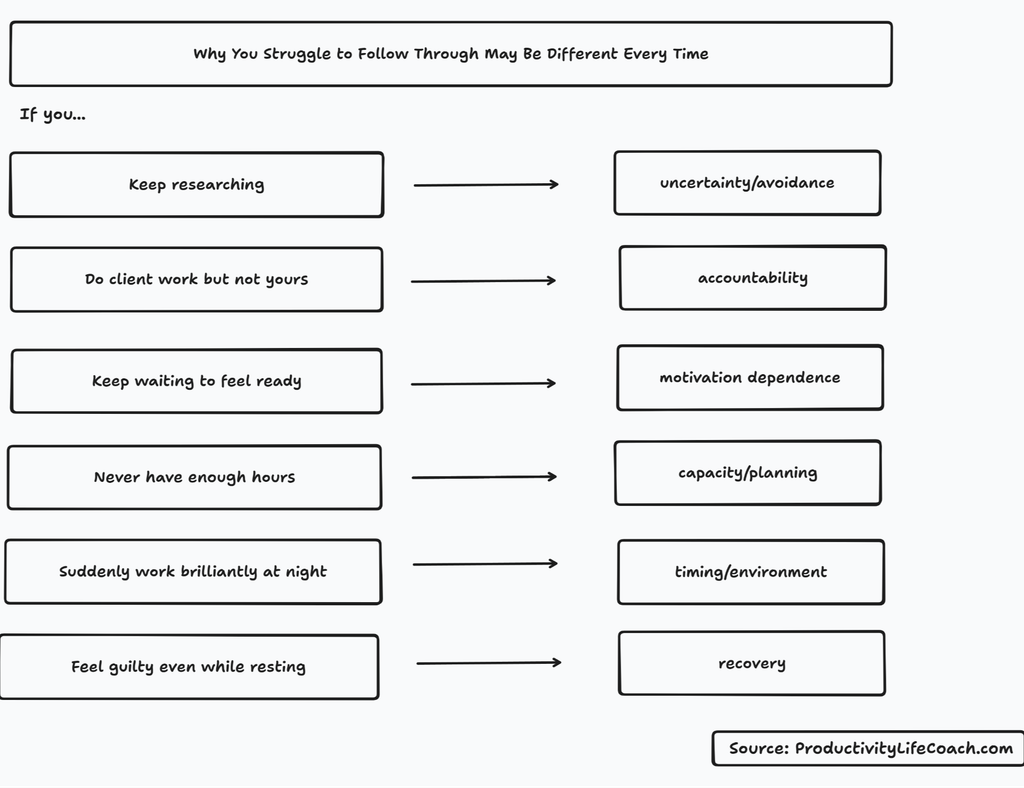
Why You Don’t Follow Through May Be Different Every Time ?
This is perhaps the most important part.
There is no single reason why you struggle to follow through.
One task may be unclear.
Another may scare you.
Another has no external consequence.
Another keeps being scheduled during your lowest-energy hours.
And another simply does not fit into the amount of time you have.
That is why one productivity strategy rarely fixes everything.
A Pomodoro timer cannot solve an unrealistic workload.
A better calendar cannot remove perfectionism.
Motivational videos cannot create accountability.
Getting up at 5 a.m. will not help if your strongest working hours come later.
You first need to diagnose the right problem.
What Actually Improves Follow-Through?
The next time something important keeps moving from today to tomorrow, resist immediately concluding:
“I need more discipline.”
Instead, ask what actually happened.
- Do I know exactly what the next action is?
- Am I avoiding something uncomfortable about this task?
- Does another person’s work always become more urgent than mine?
- Am I waiting until I feel motivated?
- Did I genuinely have enough time today?
- Am I scheduling difficult work when my energy is poor?
- Would external accountability help?
Then change the system according to the answer.
- Make the task smaller.
- Protect time for it.
- Move it to a better working period.
- Create an if-then plan.
- Reduce the workload.
- Or add external accountability.
Follow-through becomes much easier to improve once you stop treating every failure to act as the same problem.
When You Still Can’t See What Keeps Happening ?
You can work through many of these patterns yourself.
Sometimes simply paying attention for a week reveals that your own work always disappears behind client work, that “research” appears whenever you are nervous about publishing, or that your Monday plan regularly contains enough work for three days.
But sometimes you can see the pattern and still keep repeating it.
That is where outside support may help.
A productivity coach can help you examine what repeatedly happens between making a plan and acting on it while providing structure and accountability.
A time management coach may be particularly useful when the problem involves capacity, prioritization, scheduling, and how your available hours are actually being used.
Neither should simply give you prettier plans.
The useful question is still: “What happened?”
Follow-Through Is Not About Becoming Perfectly Productive
You will still procrastinate sometimes.
You will still underestimate a project.
You will occasionally ignore the task you carefully scheduled and spend forty minutes doing something completely unnecessary.
The goal is not to become somebody who follows every plan perfectly.
It is to stop experiencing your own behavior as a mystery.
Instead of ending another week with:
“What is wrong with me?”
you want to be able to say:
“Ah. That’s what happened.”
Because a lack of follow through is not always a character flaw.
Sometimes it is information.
- Information about what you avoid.
- What motivates you
- What exhausts you.
- What you prioritize.
- When you work best.
- How much you can realistically handle.
- And what kind of structure helps you act.
You do not need to become better at forcing yourself through every obstacle.
You need to become better at recognizing which obstacle is actually there.
That is where follow-through begins.
Frequently Asked Questions (FAQs)
What Is Follow Through?
Follow-through is the process of turning an intention or commitment into action and continuing until the relevant task is completed. It depends not only on motivation but also on clear actions, realistic planning, accountability, and supportive working conditions.
Why Don’t I Follow Through on Things?
You may struggle to follow through because the task is unclear, overwhelming, uncomfortable, or easy to postpone. Unrealistic workloads, weak accountability, low energy, perfectionism, and competing priorities can also interfere with action.
Why Do I Struggle to Follow Through Even When I Know What to Do?
Knowing what to do does not automatically remove the behavioral or emotional barriers to doing it. This gap between knowledge and action is often described as the knowing-doing gap.
Is Lack of Follow Through the Same as Laziness?
Not necessarily. A lack of follow-through can occur even when you are working hard. The more useful question is what repeatedly gets between your intention and action.
How Can I Improve My Follow-Through?
Identify why the task is repeatedly not happening. Make the next action specific, plan around realistic capacity and energy, protect time for important work, and create accountability when external structure helps.
Can a Productivity Coach Help With Follow-Through?
A productivity coach may help when you repeatedly understand what needs to happen but struggle to translate your plans into action. Coaching can provide accountability while helping identify patterns that repeatedly interfere with follow-through.
References & Further Reading
For readers interested in exploring the psychology and behavioral science behind procrastination, motivation, goal pursuit, recovery, chronotype, and time management:
Claessens, B. J. C., van Eerde, W., Rutte, C. G., & Roe, R. A. (2007). A review of the time management literature. Personnel Review, 36(2), 255–276. doi: 10.1108/00483480710726136
Facer-Childs, E. R., Boiling, S., & Balanos, G. M. (2018). The effects of time of day and chronotype on cognitive and physical performance in healthy volunteers. Sports Medicine – Open, 4(1), Article 47. doi: 10.1186/s40798-018-0162-z
Gollwitzer, P. M. (1999). Implementation intentions: Strong effects of simple plans. American Psychologist, 54(7), 493–503. doi: 10.1037/0003-066X.54.7.493
Lally, P., van Jaarsveld, C. H. M., Potts, H. W. W., & Wardle, J. (2010). How are habits formed: Modelling habit formation in the real world. European Journal of Social Psychology, 40(6), 998–1009. doi: 10.1002/ejsp.674
Locke, E. A., & Latham, G. P. (2002). Building a practically useful theory of goal setting and task motivation: A 35-year odyssey. American Psychologist, 57(9), 705–717. doi: 10.1037/0003-066X.57.9.705
Macan, T. H. (1994). Time management: Test of a process model. Journal of Applied Psychology, 79(3), 381–391. doi: 10.1037/0021-9010.79.3.381
Roenneberg, T., Wirz-Justice, A., & Merrow, M. (2003). Life between clocks: Daily temporal patterns of human chronotypes. Journal of Biological Rhythms, 18(1), 80–90. doi: 10.1177/0748730402239679