

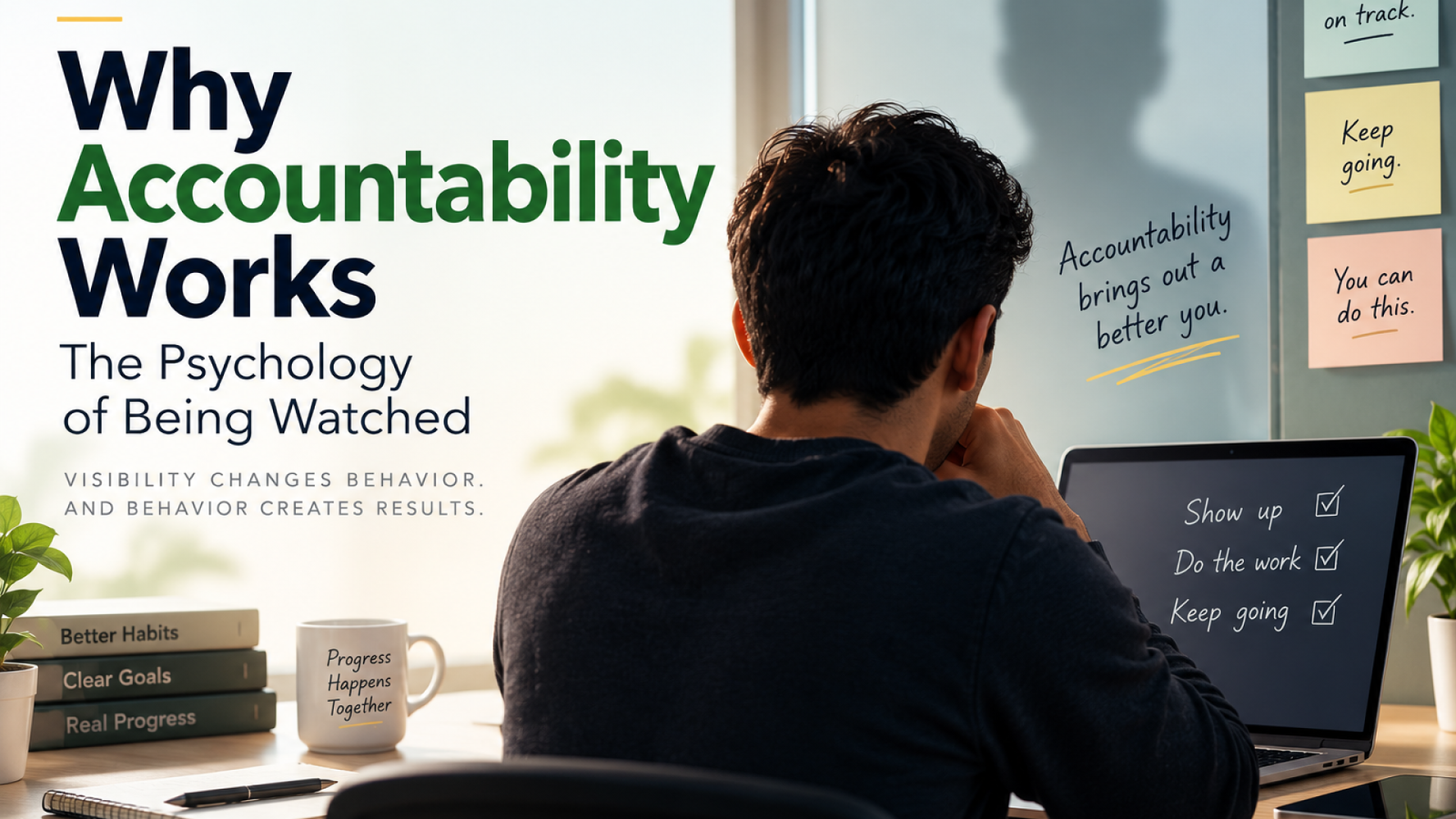
Why accountability works is easier to understand when you look at what happens when someone knows their work is being observed.
In the late 1920s, researchers at the Hawthorne Works factory outside Chicago spent years trying to find the lighting level that made workers most productive.
In the late 1920s, researchers at the Hawthorne Works factory outside Chicago spent years trying to find the lighting level that made workers most productive. They dimmed it. Productivity went up. They brightened it. Productivity went up again. Eventually they realized the lighting was never the variable that mattered. The workers knew they were part of a study. Someone was paying attention to their output, and that alone changed how they worked.
That finding got a name, the Hawthorne effect, and it’s been debated and re-examined for a century since. But the core observation has held up in setting after setting: people behave differently, and often better, when they know they’re being watched. Not because watching adds skill or information. Because it changes what the moment costs to skip.
Observation changes the cost of skipping, not the difficulty of the task
Here’s what actually happens when you know someone’s watching. The task itself doesn’t get easier. Writing the proposal, making the call, finishing the draft, none of that changes in difficulty. What changes is the cost of not doing it. Skipping a task when no one’s tracking it costs you a private disappointment you can quietly negotiate away. Skipping it when someone’s expecting a report costs you an actual, external, slightly uncomfortable conversation. Your brain weighs those two costs completely differently, even though the task is identical.
This is why willpower alone loses so often to well-designed accountability, and it isn’t a character flaw. Willpower asks you to supply, from scratch, in the moment, the exact motivation a deadline or an audience would have supplied for free. That’s an expensive way to get the same outcome. Most people don’t lack discipline. They lack a structure that makes the cost of skipping visible before they’re already mid-skip.
This is the actual mechanism behind the method
This is why the coaching structure isn’t built around pep talks or motivation. It’s built around making your own progress visible to you, consistently, before you have the chance to quietly let it slide.
The Weekly Planning Blueprint does the first half of the work the Hawthorne workers got for free: it makes the target specific and visible, so there’s a clear number to compare yourself against, not a vague sense of “being productive.” Body-Double Sessions do the second half. Working alongside someone else, even silently, recreates the exact condition from that factory floor. You’re not being corrected or managed. You’re just seen, and that alone changes how you show up. The daily check-ins close the loop. They turn “I’ll probably get to it” into a specific, visible report that either happened or didn’t, on a timeline short enough that skipping it once is noticeable to you before it becomes a pattern.
This week’s experiment:
Pick one task you’ve been circling today. Before you start it, tell one specific person what it is and when you’ll report back that it’s done. Notice how differently you approach the task once someone outside your own head is expecting an update.
Worth Your Attention:
One useful distinction from recent behavioral research: commitment devices and accountability partnerships work through different mechanisms and suit different people. Structural constraints and built-in costs tend to work best for people who need external limits on their own choices, while visibility and reciprocal check-ins tend to work best for people who respond to being seen by another person. Worth knowing which one you actually are before you build a system around the wrong assumption.
A question worth sitting with:
Which commitments become easier to keep when they are no longer private?
Maybe it’s the proposal you’ve been avoiding. Maybe it’s the workout you keep postponing. Maybe it’s the project you’ve been meaning to start for three weeks.
Instead of asking yourself to try harder, experiment with making one of those commitments visible.
Write down exactly what you’re going to do. Decide when you’ll do it. Then tell someone who will actually notice whether you followed through.
Pay attention to what happens.
If having your commitments visible helps you follow through, that’s useful information. It means you may not need more motivation. You may need better accountability built into the way you work.
If you want to start with your own system, you can use The Ultimate Weekly Planning Blueprint to turn your intentions into clear commitments for the week.
And if you work better when someone is actually there with you, Body Double Accountability Sessions provide a simple way to work alongside someone while keeping the focus on the task itself.
The objective isn’t dependence on accountability.
It’s discovering what kind of structure helps you consistently do what you already decided matters.
Until next Tuesday,
Stay intentional. Stay Productive.

