

How to Follow Through Without Relying on Motivation ?
How to follow through without relying on motivation is a question worth asking if you’ve ever made a plan with good intentions, only to find yourself struggling to start a few days later.
Two people sit down to the same Monday morning task list.
One checks in with how they’re feeling first.
Tired. A little behind. Not really in the mood.
They decide to start with something easier and circle back once they’re “in a better headspace.”
The other doesn’t check in with anything. They open the same document they always open at the same time, and they’re working before the question of how they feel has a chance to come up.
By Wednesday, the gap between those two mornings has compounded into a very different week.
Not because one person necessarily has more discipline than the other.
Because one built their follow through around something that changes daily, while the other built it around something that stays relatively consistent.
Motivation Is Useful, But It Can’t Be the Requirement
Motivation can certainly help you get started. But what happens when you make it a requirement?
Your motivation changes with your sleep, energy, workload, environment, and what happened earlier in the day. You can’t always control those things.
So if your plan depends on feeling motivated before you begin, your follow through becomes vulnerable to everything affecting your emotional state.
You didn’t necessarily fail because you lack discipline.
Perhaps your plan simply asked motivation to make the opening move.
And some days, motivation doesn’t show up.
A more useful question might be:
What could help me begin even when I don’t feel particularly motivated?
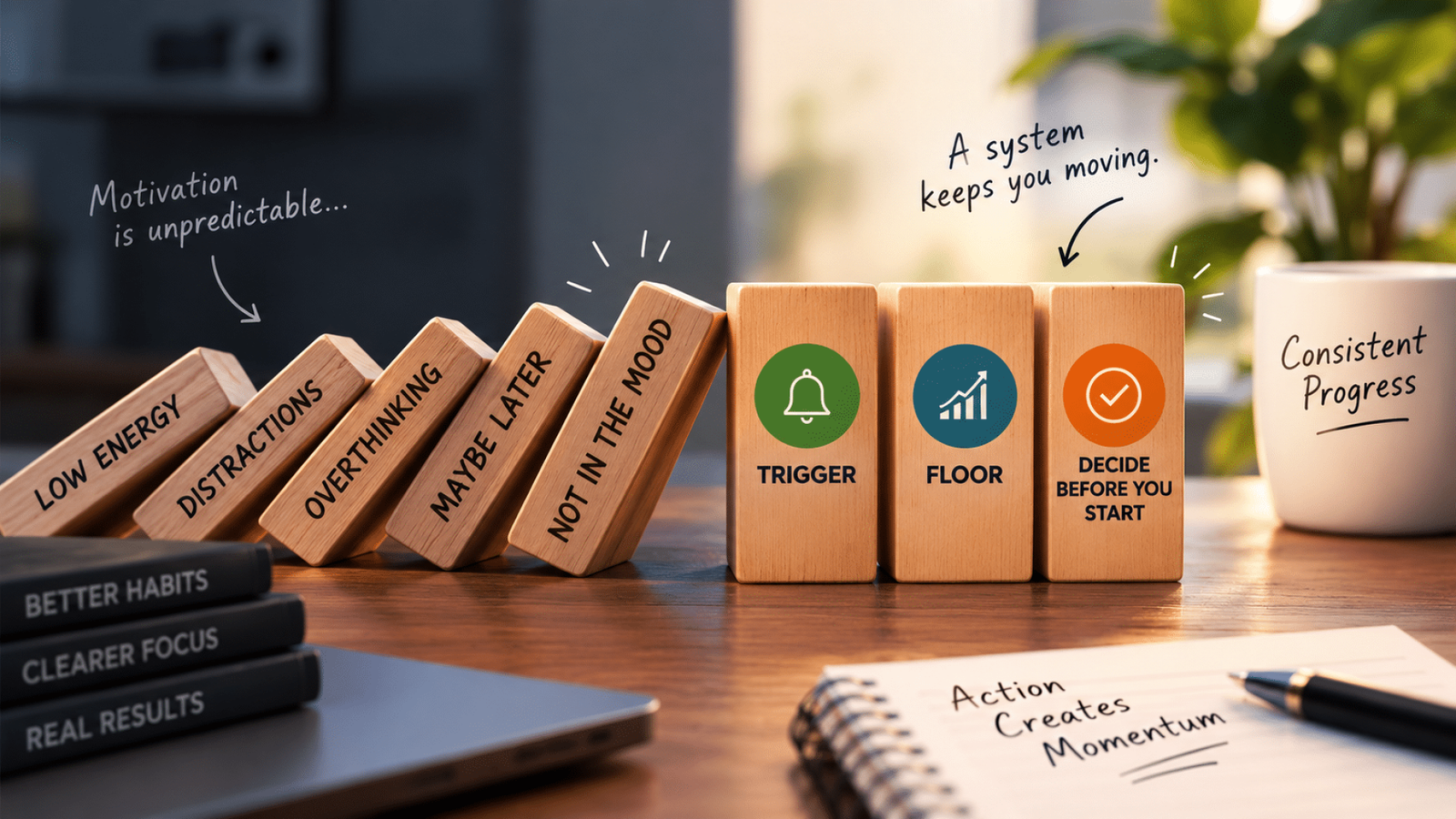
A System Needs Three Parts
A system that can survive a difficult day has three components. Each removes a decision that your feelings would otherwise get a vote on.
1. The Trigger
The first is a trigger: a fixed cue that tells you it is time to begin.
Not:
“I’ll do it when I feel ready.”
Instead:
“At 9:00 AM, I sit at my desk and open the document.”
It could be a specific time, place, or action that happens immediately before the task.
Ask yourself:
What could become my cue to start?
The goal isn’t to create a perfect routine. It’s to make the beginning predictable enough that you don’t have to negotiate with yourself every time.
2. The Floor
The second is a floor: the smallest version of the task you’d still consider a win on a difficult day.
Not your ideal output.
The minimum that still counts as showing up.
If your goal is to write, perhaps your floor is 100 words.
If your goal is to study, perhaps it’s 20 minutes.
If your goal is to exercise, perhaps it’s a short workout.
But have you decided what your minimum is before the difficult day arrives?
Without a floor, we often compare our current capacity with our ideal performance. If we can’t meet the ideal, we skip altogether.
A floor gives you another option:
“What is the smallest meaningful action I can take today?”
3. Decide Before You Start
The third is deciding in advance what you will do first.
Think about what happens when you sit down without a clear starting point.
You check your email.
Look at your task list.
Reorganize a few things.
Check your phone.
Suddenly, twenty minutes have passed without actually starting.
So ask yourself:
Which decision do I keep making repeatedly that could be made once in advance?
Decide the first action while your mind is clear. Then, when the trigger arrives, you don’t have to figure it out again.
The decision has already been made.
Where Accountability Comes In ?
Accountability isn’t simply someone asking, “Did you do it?”
It also means being honest about the commitment you’ve made.
If you repeatedly tell yourself, “I’ll do it when I have enough time” or “I’ll start when I feel motivated,” what kind of commitment have you actually created?
A stronger commitment answers four questions:
What will I do? When will I do it? What counts as enough? What will I do when the day doesn’t go according to plan?
You don’t need to promise yourself that you’ll perform at your best every day.
You need to decide what you’re willing to be responsible for, even when the conditions aren’t ideal.
Your Experiment This Week.!
Choose one task you keep intending to do consistently.
Then answer three questions:
- What will trigger me to start?
- What is my floor on a difficult day?
- What decision can I make now so I don’t have to make it again in the moment?
Test your system for one week.
If you have more energy, do more.
If you have less energy, return to your floor.
At the end of the week, don’t only ask whether you completed everything.
Ask:
What did I learn about the way I follow through?
And:
Where does motivation currently have the biggest say in whether I take action?
A Question Worth Sitting With
What would your week look like if it never had to wait on how you felt before you started?
You don’t need to eliminate difficult days.
You don’t need to manufacture motivation every morning.
You may simply need a better structure around the commitments you already care about.
Build the trigger.
Set the floor.
Decide before you start.
Then notice what happens when motivation no longer gets the final say.
If you know what you want to accomplish but keep finding yourself caught between intention and execution, that’s a gap we can work through together.
Book a free clarity session with me to explore what is getting in the way of your follow through and what kind of accountability structure could support you.
Until next Tuesday,
Stay Intentional. Stay Productive.

